
For homeowners
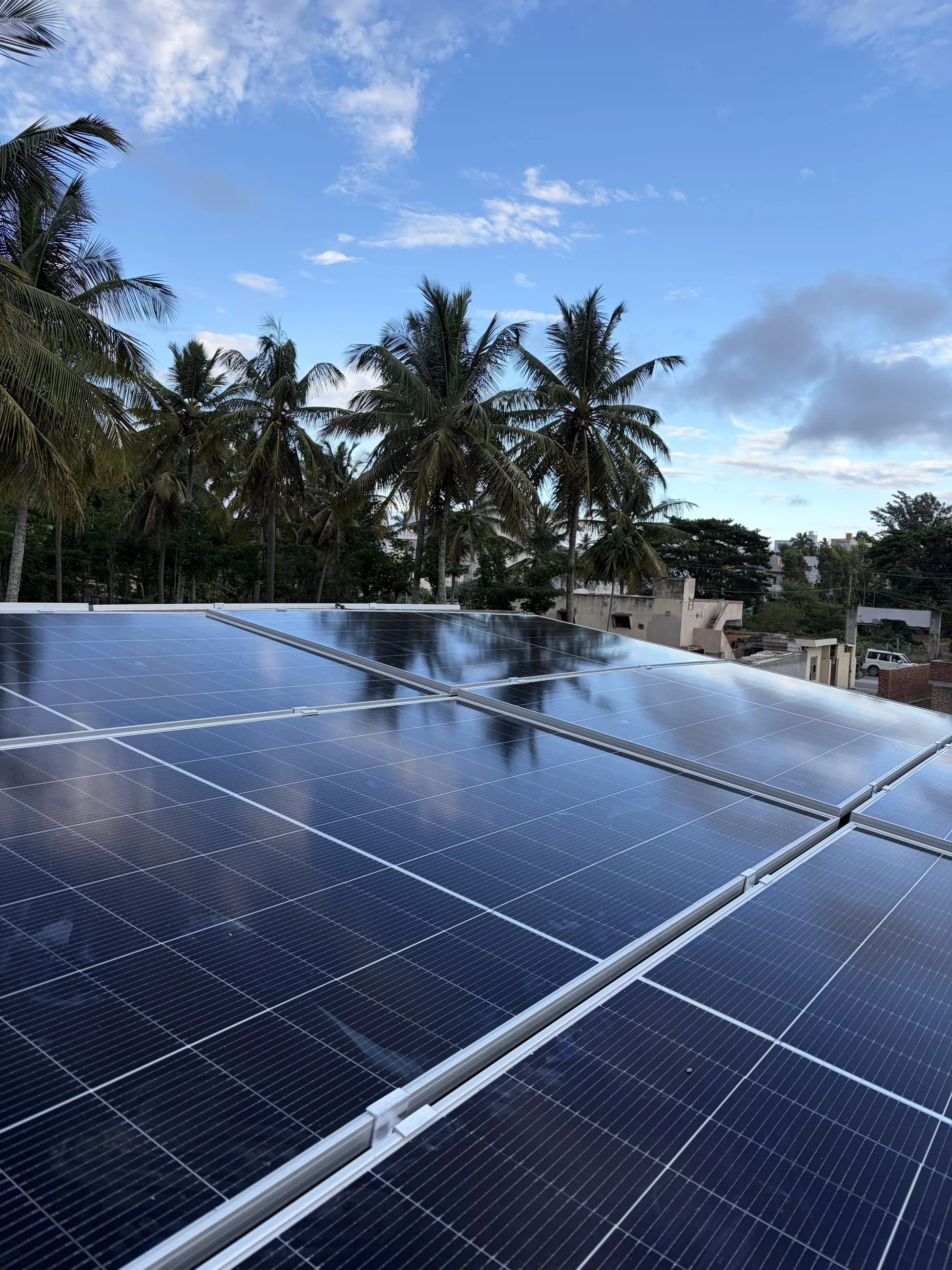
Solar for your home in Karnataka — designed end-to-end.
From site visit to installation, we handle it. You see the savings on your bill every month.
How it works
Your solar journey, simplified.
Free site visit & rooftop design
We measure your roof, check shading and load, and design a system that makes the most of your space.
Personalised plan
You'll see how the panels will sit on your roof — with savings projections in rupees, before you commit to anything.
We install. We handle the subsidy.
We do the discom and government paperwork.
Switch on. Save.
Your system goes live, your bill drops the same month.
Choose what fits
Which solar system suits your home?
Not sure which is right? Our team will help you decide on the call.
- On-Grid
Stay connected, sell extra power
Your roof powers the home; the surplus goes to the grid as a bill credit. Most popular for homes with steady electricity.
- Off-Grid
Be fully independent with batteries
Your roof + a battery pack. Zero dependence on the grid, even during outages. Right for places with bad supply or remote properties.
- Hybrid
Best of both — power + backup
Run on solar by day, store the extra in batteries, and fall back to the grid only if you need to. The most resilient option.
Why us
Built around your roof and your bill.
Honest savings, in rupees
We don't quote a percentage. We show you the rupee number you'll save every month, based on your bill and tariff slab. No surprises.One team, end-to-end
From site visit to after-sales, all done by Irradiant directly. No middlemen, no finger-pointing.5-year free maintenance
Cleaning, monitoring and parts — we come to you.
Questions, answered
Frequently asked questions
If your question isn't here, ping us on WhatsApp.
Still have questions?
Talk to our team on WhatsApp, or call us.
Under the PM Surya Ghar scheme, residential systems get ₹30,000 to ₹78,000 in central subsidy depending on system size.
Typically 30–45 days end-to-end: about a week for design and approval, 2–3 days to install, and the rest is discom inspection and meter changeover.
Roughly 100 sq ft per kW, so a 3 kW system needs ~300 sq ft of unshaded roof. Tight on space? Elevated structures often free up more area — that's what the site visit is for.
We do — the discom application, net-metering agreement, structural certification and subsidy claim. You sign two documents.
Yes — modern panels still generate 10–25% of peak output on cloudy days, and rain helps by washing off dust. Net-metering carries sunny-day surplus forward to offset cloudy-day usage.
On-grid: roof powers the home, extra goes to the grid for credit, no battery. Cheapest, most popular. Off-grid: roof + battery, fully independent, no grid connection. Best for poor-supply areas. Hybrid: roof + battery + grid, runs on solar by day and falls back to grid only when needed. Most resilient, slightly costlier.
Ready to see your savings?
Free site visit. Free quote. Zero pressure.